Why is an air pump the "lifesaver" of your hydroponic system?
Oxygen in the Summer: Why is an Air Pump the "Lifesaver" of Your Hydroponic System?
Many hydroponic growers in Israel are discovering the hard way that summer is the roots' biggest enemy. While the leaves enjoy the sun, the roots in the water tank can suffocate. In this article, we will understand the scientific connection between temperature and oxygen, and explain why Air pump and air stone They are a must-have piece of equipment for any hydroponic system during the warm season.
1. The Science Behind Water: Temperature vs. Dissolved Oxygen
The most crucial factor in summer hydroponics is dissolved oxygen. There is a clear inverse physical relationship: as the temperature of the water increases, its physical ability to hold oxygen molecules decreases (according to Henry's Law).
At a temperature of 20°C: Water can hold about 9.1 mg/liter of oxygen.
At a temperature of 30°C: The capacity drops to about 7.5 mg/liter (a decrease of almost 20%).
In parallel with the decrease in supply, The plant's demand for oxygen increases The hotter it gets, the faster its metabolic rate increases. Without an air pump, a "choke gap" is created that leads to system collapse.
2. Why must roots breathe?
Roots do not perform photosynthesis; they perform Cellular respirationThis process requires oxygen to produce energy (ATP). Oxygen available in the roots enhances:
Active mineral absorption: Nutrients like nitrogen, phosphorus, and potassium don't "float" into the plant; they are pumped in through a process that requires energy. Without oxygen, the plant will show signs of deficiency even if the water is full of fertilizer.
Growth hormone production: Well-oxygenated roots produce cytokinins, hormones that encourage leaf growth and flowering.
3. The benefits of air stone on hot days
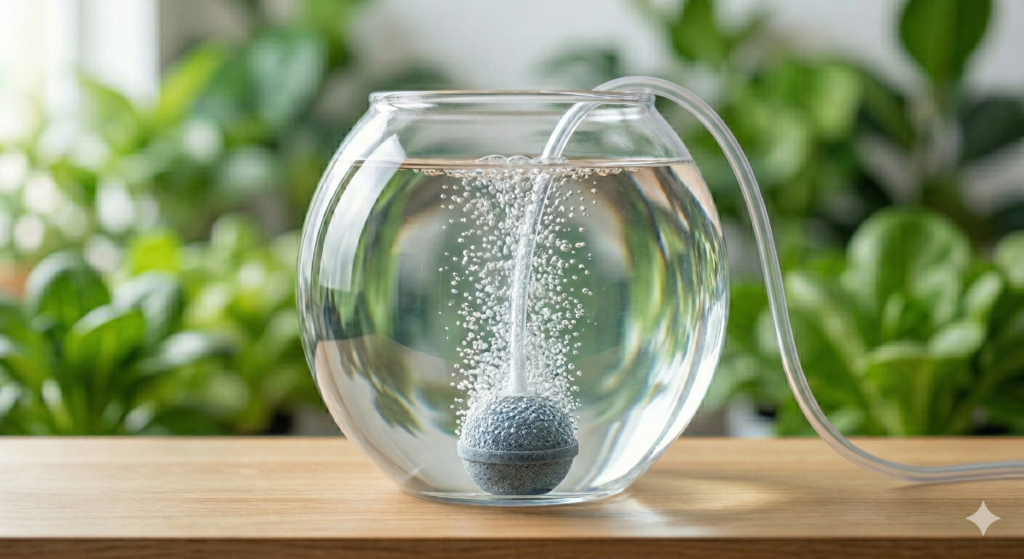
Installing an air stone not only adds oxygen, but creates several critical effects:
A. Fighting pathogens (root rot)
Destructive bacteria and fungi such as Pythium (root rot) thrive in an anaerobic (low oxygen) and warm environment. Enriching the water with oxygen creates a hostile environment for these pests and encourages the development of beneficial (aerobic) microorganisms.
B. Cooling through evaporation
The bubbling action breaks the surface tension of the water and increases the area of contact with the air. This process encourages slight evaporation, which can lower the temperature of the feed solution by a critical 1-2 degrees below ambient temperature.
C. Homogeneity of the feed solution
On hot days, fertilizers tend to sink or concentrate in certain layers due to density changes. The agitation of the air stone ensures that each root receives an even mixture of water, fertilizer, and oxygen.
4. Tips for maximizing oxygenation in the summer
Bubble size: Opt for air stones that produce “microbubbles.” The smaller the bubble, the greater its surface area and the better oxygen is absorbed into the water.
Pump location: Place the pump in a cool place. If the pump is drawing 40-degree air from a hot greenhouse, it is actually heating your water.
Backup: In the Israeli summer, a two-hour power outage without hot water oxygenation can wipe out months of harvest. It is recommended to have a battery-operated air pump for emergencies.
Summary
Adding an air pump and air stone isn’t a “treat” – it’s your insurance against the summer heat. Increasing dissolved oxygen levels will ensure white roots, drought-resistant plants, and a bountiful harvest even when temperatures outside are climbing.
Sources of information and scientific basis:
Journal of Experimental Botany: Studies on the effect of lack of oxygen (Hypoxia) on roots and nutrient absorption
University of California (UC ANR): A guide to managing hydroponic systems and solving root problems
Engineering ToolBox: Henry's Law Tables – Solubility of Oxygen and Gases in Water by Temperature
University of Minnesota Extension: Nutrient solution management and the importance of oxygenation in hydroponics
Oklahoma State University: The effect of temperature and pH on the success of hydroponic growing