
Balancing metrics in hydroponics systems
This page will describe the process of checking the indicators and balancing them as required in Vinea's hydroponic systems ( (pH/EC)Since the success of crops in hydroponic systems is based primarily on the application of a precise nutrient solution containing all the microelements and minerals necessary for the specific crop (in the absence of a soil substrate), it is crucial to understand the fertilization process and balance the acidity in the various systems. At Vinea Green you can find combined hydroponic fertilizers (water-soluble) that are adapted to all hydroponic systems in terms of the composition of microelements and minerals (N.P.K.) required for the plant throughout the various growth stages. In general, we recommend checking the indicators in the systems and balancing them if necessary once a week or after filling the tank.
System fertilization procedure using an electrical conductivity meter (EC):
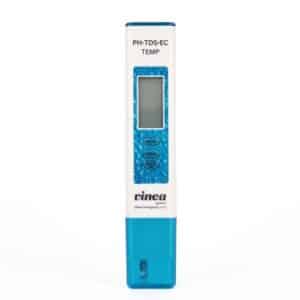
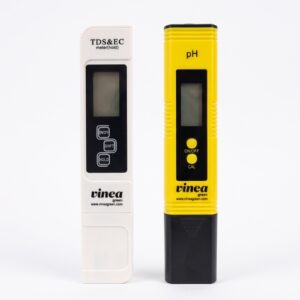
Before fertilizing the hydroponic system, the electrical conductivity value present in the water (i.e. the Electrical Conductivity – EC) must be verified using a dedicated electrical conductivity meter, which will digitally display the concentration of dissolved salts in the water (a higher amount of salts in the water will translate into a higher EC value and vice versa). It must be taken into account that tap water already naturally contains salts (such as calcium, sodium, etc.) that may increase the electrical conductivity of the water by various values (EC usually between 400 and 700 on average), which must be taken into account as part of the balance of the indicators in the system. The EC value can be lowered by adding water or raised by adding fertilizer. The fertilization process and the accompanying notes must be read carefully before actually carrying out the procedure.
The fertilization procedure is detailed below:
- Checking the EC value in tap water + adding clean water to the system tank if necessary.
- Check the EC value required for the specific crop, sometimes it also appears on the back of the fertilizer container (sample crops are attached).
Type of tumor | Values EC Averages |
cucumber | 1700-2500 |
Tomato | 2000-3500 |
basil | 1000-1600 |
lettuce | 800-1200 |
eggplant | 2500-3500 |
pepper | 2000-3000 |
- Adding fertilizer in a controlled manner to the hydroponic system tank until the desired EC value is obtained.
- Mix the water and fertilizer in the container and wait about fifteen minutes to get a more accurate result of the EC value in the system.
- If the EC value is lower than desired after waiting 15 minutes, add more fertilizer until the desired value is obtained.
- Rinse the EC meter electrodes with tap water, dry with absorbent paper, and turn off the device.
** Notes:
- In general, it is recommended to fertilize green leafy vegetables until they reach average EC values of 1500-2000µS, and fruiting vegetables (such as cucumber, tomato, eggplant) until they reach average EC values of 1900-2500µS.
- Make sure to fill the container with water before starting the fertilization process.
- Make sure that the water tank is clean of leaves or other debris (hydroton residue, insects, etc.) before starting the fertilization process.
- Do not immerse the EC meter below the level of the electrodes, which may cause damage to the device and hence inaccurate measurement.
Emptying the reservoir in case of over-fertilization:
When fertilizer is given above the average values, the following procedure must be followed until EC values are obtained that are corrected according to the type of crop.
- Empty the water tank halfway (by opening the rubber band at the bottom of the tank)
- Refill the tank with clean tap water (add about 50% clean tap water)
- The EC value must be measured.
- If the given EC value obtained is lower than the recommended values according to the type of crop, fertilizer should be added carefully according to the procedure described above.
pH balancing procedure (Ph) in the system using an acidity meter:
The pH index in the hydroponic system is fundamental for understanding the degree of alkalinity or acidity in the system. The pH range ranges from 0 to 14, with a value above 7 (7-14) representing a more basic solution and below 7 (0-7), a more acidic solution. A pH value of 7 represents a neutral solution (for example, tap water). Understanding the pH value in the system is critical to the success of the crop, since different crops have different acidity requirements. In general, it is recommended to ensure that the pH value in the system does not exceed 6.5 and does not fall below 5.5. Deviation from these values may be reflected in a lower efficiency of the nutrient solution, since various nutrients that are critical to the success of the crop may be delayed in their availability and lead to a decrease in the quality of the final product. In the planning stages of planting in the hydroponic system, it is worth ensuring that all intended plants require pH values of a similar order of magnitude.
Using the meterpH:
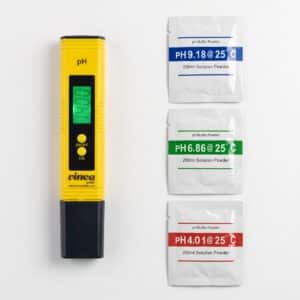
We recommend using a digital pH meter over other types of meters, as this measurement is relatively accurate and simple. It should be taken into account that new pH meters do not come calibrated. The meter must be calibrated using the calibration solution before using it to test the pH value in the hydroponic system (instructions for calibrating the meter come separately with all Vinea pH meters).
The procedure for balancing acidity in the system is described below:
** The acidity test in the system should only be performed after the fertilization process has been completed as described above.
- Immerse the pH meter in the tank up to the level of the electrodes (see example from the EC meter) and wait a few minutes until the reading stabilizes at a specific value.
- If the pH value is higher than the average range (i.e. low acidity), use pH down until the desired value is reached and the optimal range for hydroponic growing is returned. Since this is a concentrated acid, the liquid should be applied gradually and in a controlled manner to the system tank. We recommend waiting at least a minute for the reading to stabilize and repeating the operation with lower amounts of the product if necessary, while regularly checking the current pH value.
- If the pH value is below the average range (i.e. high acidity), you can add tap water to the tank (be careful not to overfill) or use a pH up product until the desired value is reached and the optimal range for hydroponic growing is returned. Since this is a concentrated product, the liquid should be applied gradually and in a controlled manner to the system tank. We recommend waiting at least a minute for the reading to stabilize, mixing the water a little and repeating the operation with small amounts of the product if necessary, while also regularly checking the current pH value.
- At the end of the balancing process, rinse the pH meter electrode with tap water, dry with absorbent paper, and turn off the device.
Link to Wikipedia Hydroponics – Click here
Link to Hydroponics Projects – Click Here

-

Hydroponics Supplement Kit
₪250.00 – ₪400.00Price range: ₪250.00 to ₪400.00 This product has several types. You can choose the options on the product page. -
operation!

VINEA 1 – Liquid fertilizer for hydroponics and soil
₪35.00 – ₪110.00Price range: ₪35.00 to ₪110.00 This product has several types. You can choose the options on the product page. -
operation!

pH Down – increases acidity
₪90.00The original price was: ₪90.00.₪80.00The current price is: ₪80.00. -

Clear-Guard – Hydrogen Peroxide – Disinfectant for Hydroponics Systems
₪75.00 -

pH Up – increases alkalinity
₪90.00 -

Kangaroo Boost – Microelement Supplement
₪57.00 -

Magical Whale – Calcium and Magnesium Supplement
₪70.00